Charizard
Flame Pokémon
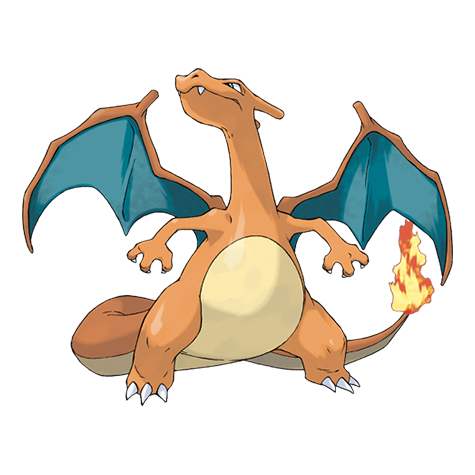
Spits fire that is hot enough to melt boulders. Known to cause forest fires unintentionally.
- Height
- 1.7 m
- Weight
- 90.5 kg
- Base XP
- 240
- Catch
- 45 /255
- Happy
- 70
- Hatch
- 20 steps

- HabitatMountain
- Body shapeUpright
- ColourRed
- Growth rateMedium Slow
- Egg groupsMonster, Dragon
- RarityStandard
Charizard is the Flame Pokémon, a Fire and Flying type introduced in the first generation of catalogued species. Bipedal and upright, it stands roughly as tall as a broad-shouldered adult human, though its wingspan extends considerably beyond that measurement. Its body is covered in deep orange scales with a pale cream tone along the underside from chest to tail base. Two large, bat-like wings emerge from its back, built for sustained high-altitude flight. The tail tapers to a point from which a continuous flame burns without interruption, a feature present since the creature's earliest days and one whose intensity varies with its health and emotional state. Curved horns extend from the rear of its skull, and its clawed limbs carry sufficient strength to score bare stone. Despite an unmistakable visual resemblance to legendary dragons, Charizard belongs taxonomically to the Monster and Dragon egg groups, a distinction that gives it a fascinating position among the broader roster of known species.
Charizard inhabits mountainous terrain, showing a strong preference for high elevations where bare rock and reliable thermal updrafts make sustained flight efficient. It favors volcanic ridgelines and exposed clifftop roosts, patrolling its territory on the wing during the warmer hours of the day. In the wild it is strictly solitary; one individual may claim a range spanning several peaks and defends that territory with considerable force. Documented wild populations are sparse, as most Charizard known to researchers have been raised from eggs by trainers rather than encountered in undisturbed habitat. Its preference for altitude keeps it removed from forests and populated settlements, but field reports consistently note that when hunger or the search for a worthy challenger draws it to lower elevations, wildfires can result from the heat of its breath alone.
Charizard is shaped equally by fierce pride and considerable intelligence. It consistently refuses to engage opponents it judges significantly weaker than itself, a behavior observers interpret as a deeply ingrained sense of personal honor and a persistent instinct toward genuine challenge. When denied worthy competition it grows restless and at times openly defiant. Toward trainers who have earned its loyalty through years of sustained effort and shared difficulty it is attentive and committed; toward those it considers unworthy of partnership it is contemptuous and difficult to direct. It hunts large prey by descending from altitude at speed, using the power of its wings to close distance before delivering fire. The tail flame brightens when the animal is in peak physical condition or emotionally agitated, and experienced handlers read it as reliably as they would a partner's expression. Wild nesting habits remain poorly documented, though individuals are believed to return to favored high-altitude roosts across multiple seasons.
In battle Charizard functions primarily as a special attacker, with its strongest contributions coming through Fire-type offense. Its standard ability, Blaze, activates when it has sustained significant damage, at which point its fire-based attacks surge in power, rewarding aggressive tactics while demanding that the Pokémon fight near the edge of its endurance. Its hidden ability, Solar Power, takes this further: under harsh sunlight it dramatically amplifies special attack output each turn at the cost of the Pokémon's own vitality, a trade that demands battles under those conditions be concluded swiftly and decisively. As a Fire and Flying type, Charizard resists a broad range of common attack categories, and its Flying typing specifically cancels the Ground weakness that would otherwise accompany its Fire typing. Remaining vulnerabilities to Water, Rock, Electric, and Ice represent genuine threats, with Rock attacks in particular carrying compounded severity. Its speed sits comfortably above the midline for fully evolved species, supporting an offensive style that prefers dictating pace over absorbing punishment.
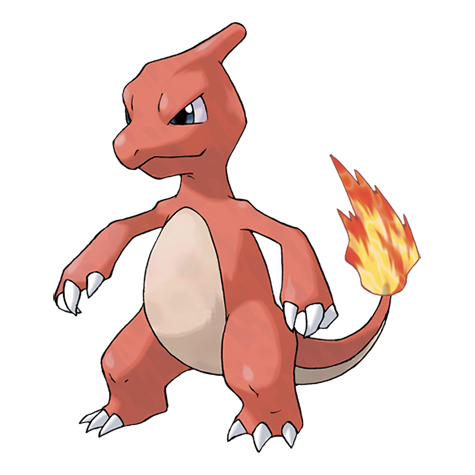
Charizard is the final form of a three-member evolutionary line that begins with Charmander, a small, lizard-like Fire type whose burning tail has become one of the most widely recognized images in the history of Pokémon training. Charmander evolves into Charmeleon at level sixteen, gaining aggression and broader physical capability, and Charmeleon completes the transformation into Charizard at level thirty-six, a threshold that brings sweeping changes to body plan, mass, and the emergence of full flight capability. This line was among the original starter Pokémon available to trainers beginning their journeys in the Kanto region, a circumstance that has made Charizard one of the most intensively studied and widely known species in existence. Researchers continue to examine the biology of its perpetual tail flame, the aerodynamics of its sustained high-altitude flight relative to its body mass, and the neurological basis of its selective responsiveness to commands. For trainers, Charizard stands as more than a powerful battler; it is an emblem of what patience, effort, and genuinely earned mutual respect can ultimately produce.