Charmeleon
Flame Pokémon
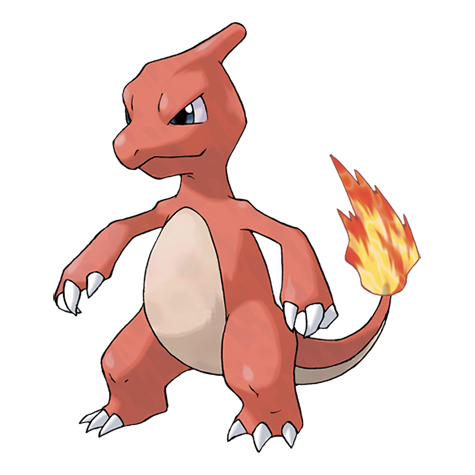
When it swings its burning tail, it elevates the temperature to unbearably high levels.
- Height
- 1.1 m
- Weight
- 19.0 kg
- Base XP
- 142
- Catch
- 45 /255
- Happy
- 70
- Hatch
- 20 steps
- HabitatMountain
- Body shapeUpright
- ColourRed
- Growth rateMedium Slow
- Egg groupsMonster, Dragon
- RarityStandard
Charmeleon is the Flame Pokémon, a pure Fire-type introduced in Generation I. It stands upright on two legs, reaching roughly the height of a young child's torso when measured to the top of its head. Its body is covered in deep crimson scales that shade toward a darker burgundy along the back and tail, while the underbelly carries a softer cream hue. A single horn-like crest curves back from the top of its skull, and its clawed hands and feet hint at the formidable fighter it is steadily becoming. The most defining feature of Charmeleon, and the one that gives its species category its name, is the blazing flame that burns continuously at the tip of its long, tapered tail. That flame holds an intense orange-red core and flares noticeably brighter in moments of excitement or combat, serving as a visible signal of the creature's inner intensity.
Charmeleon is most often found in mountainous regions, favouring rocky terrain at higher elevations where sparse vegetation and cool air contrast sharply with the heat it generates. It tends to inhabit steep ridges, volcanic foothills, and sun-baked cliffs where ambient warmth eases the metabolic cost of maintaining its tail flame. In the wild, populations are relatively sparse and unevenly distributed; trainers who have trekked mountain routes consistently report that sightings of Charmeleon are far less frequent than those of its pre-evolved form. It is a solitary Pokémon by nature, claiming and patrolling a clearly defined territory that it defends aggressively against perceived rivals or intruders. There is no strong evidence of migratory behaviour, though individuals living at altitude are sometimes observed moving to lower elevations during particularly harsh winters when prey becomes difficult to find.
Charmeleon is predominantly carnivorous, hunting smaller Pokémon and consuming prey with the efficiency of a predator that has outgrown the vulnerabilities of its earlier stage. Its feeding activity peaks in the late afternoon and early evening, when cooling mountain air drives smaller animals out of shelter and into the open. In temperament, Charmeleon is notoriously short-fused and combative; field researchers consistently note that it will attack without much provocation, especially when it perceives a challenger as weaker than itself. The intensity of its tail flame is commonly used by trainers as a mood indicator, with a roaring and erratic flame signalling agitation or fighting intent and a steadier burn suggesting relative calm. Even well-bonded Charmeleon may occasionally snap at or scratch its trainer during moments of frustration, a trait that has made it a subject of genuine interest in studies on Pokémon temperament and the evolving bond between trainer and partner.
In battle, Charmeleon leans heavily on its special offensive capability, and its Fire typing grants powerful coverage against Grass, Bug, Steel, and Ice opponents. Its standard ability, Blaze, activates when the Pokémon has taken significant damage, pushing its Fire-type moves into a higher power threshold and turning a weakened Charmeleon into an unexpectedly dangerous last-resort attacker. Its hidden ability, Solar Power, dramatically amplifies special attack output under strong sunlight at the steady cost of draining its own health each turn, making it a high-reward option in sun-team compositions that can absorb that attrition. Charmeleon moves with reasonable swiftness and tends to function as an offensive mid-field presence rather than a lead or defensive anchor. Its weaknesses to Ground, Rock, and Water moves mean that opposing trainers with access to those types hold a clear advantage, so Charmeleon performs best when its teammates provide coverage for those gaps.
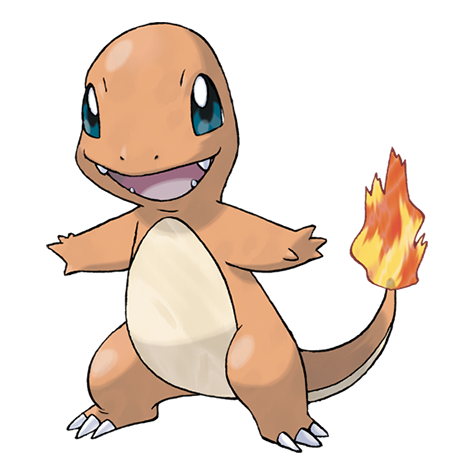
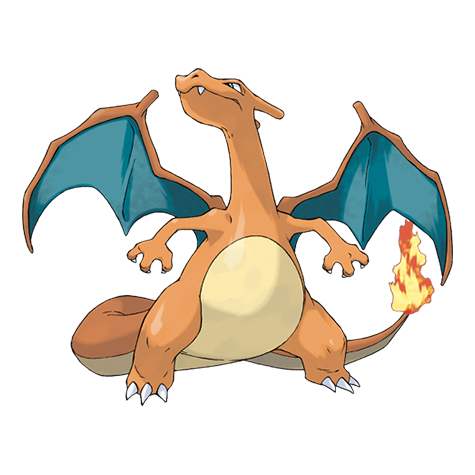
Charmeleon occupies the middle stage of one of the most iconic three-part evolutionary lines in all of Pokémon. It evolves from Charmander, the small lizard-like starter Pokémon of Kanto, at a moderate level of accumulated experience, and it will eventually evolve into Charizard once it has grown considerably stronger through continued training. The transition from Charmander to Charmeleon marks a noticeable shift in temperament, and trainers who raised a gentle and eager Charmander often find that Charmeleon is considerably more defiant and independent-minded by comparison. That behavioural shift has made Charmeleon a recurring subject in Pokémon developmental research focused on how personality and obedience change as a species passes through evolutionary stages. As a Generation I Pokémon originating from the Kanto region, Charmeleon carries historical significance as one of the original trio of starter mid-forms, and its design has quietly influenced how Fire-type intermediate evolutions have been conceived and portrayed throughout every generation since.