Charmander
Lizard Pokémon

Obviously prefers hot places. When it rains, steam is said to spout from the tip of its tail.
- Height
- 0.6 m
- Weight
- 8.5 kg
- Base XP
- 62
- Catch
- 45 /255
- Happy
- 70
- Hatch
- 20 steps
- HabitatMountain
- Body shapeUpright
- ColourRed
- Growth rateMedium Slow
- Egg groupsMonster, Dragon
- RarityStandard
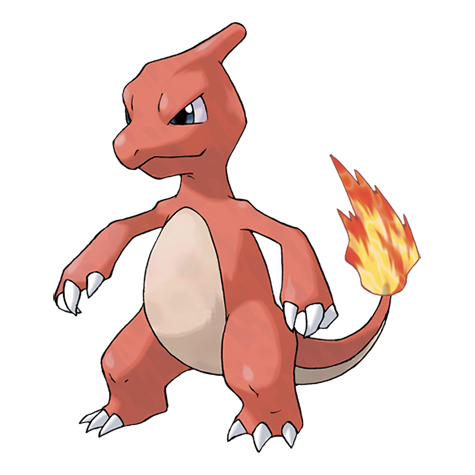
Charmander is the Lizard Pokémon, a pure Fire-type introduced in the first generation of discovered species. It stands roughly half the height of an average adult human, presenting a bipedal, upright silhouette that is compact without being bulky. Its scales are a warm, vivid orange-red across most of its body, softening to a pale cream on the stomach and the soles of its feet. The head is rounded and somewhat large relative to the body, with wide eyes and a short snout that give the species a youthful quality. Small and slender-limbed, Charmander is built less for raw power than for agility and endurance. The feature that defines this Pokémon above all others is the flame burning steadily at the tip of its tail, a biological fixture present from the moment of hatching and considered an external marker of the creature's vitality.
Charmander's natural range is centered on mountainous environments, particularly rocky slopes, volcanic foothills, and elevated plateaus where dry air and abundant sunlight keep temperatures comfortably high. It is strongly drawn to warm, sun-exposed surfaces and is most active during the late morning and early afternoon when solar heat is at its peak. In the wild, populations are sparse; Charmander is a solitary animal that claims and defends a small stretch of rocky terrain as its personal resting ground. At night it retreats into crevices or shallow caves that retain the warmth of the day. Young individuals that have not yet established territory will range more widely across highland terrain, sometimes descending to lower elevations before finding a suitable location to call home. No significant seasonal migration has been documented in this species.
Day to day, Charmander is a carnivorous opportunist. It hunts small insects, the eggs of bird Pokémon, and any small prey it can flush from scrub and rock cover, using short, controlled bursts of flame to stun targets rather than protracted fire. The condition of its tail flame is the most reliable indicator of its health: it burns high and steady in a well-rested individual, dims noticeably during illness or prolonged exertion, and is said to diminish to a near-extinction during severe physical or emotional crisis, a state that experienced trainers treat as an urgent warning. Toward humans, Charmander is cautious and observant rather than openly hostile. Field accounts consistently note that individuals separated from or abandoned by their trainers will return to the last place they met and wait there, often through rain and cold, a behavior that observers describe as a testament to the species' loyalty as much as a demonstration of its vulnerability.
In battle, Charmander's standard ability is Blaze, which causes its Fire-type attacks to become markedly more powerful when it has been pushed to the limits of its endurance. This creates a Pokémon that grows more threatening the more it is worn down, a dynamic that rewards patient, calculated play. Its hidden ability, Solar Power, functions differently: under strong sunlight it dramatically increases the potency of its special attacks at the cost of draining its own stamina each turn, making it a sharp but fragile option for sun-focused teams. As a Fire type, it is most effective against opponents with Grass, Ice, Bug, or Steel typing, and it is at a disadvantage against Water, Ground, and Rock attacks. Rock-type moves are a particular concern in practice. Among its attributes, speed stands out as its most immediate asset, allowing it to outpace many opponents at this stage of its development, while its offensive character leans toward special rather than physical power.
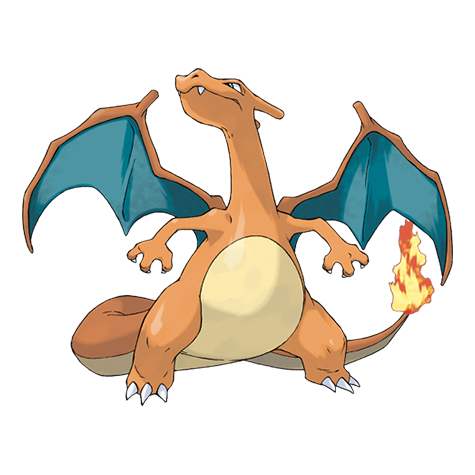
Charmander stands at the beginning of a three-stage evolutionary line that concludes in one of the most powerful and widely recognized Pokémon in existence. With sufficient training it matures into Charmeleon, and Charmeleon in turn becomes Charizard, each transition requiring only growth through battle rather than any special item or circumstance. As one of the three Pokémon offered to new trainers departing from Pallet Town in the Kanto region, Charmander occupies a culturally significant position in the wider history of Pokémon training. Researchers prize it as a study subject for Fire-type thermoregulation and tail-flame biology, while trainers value it for the substantial potential it carries forward into later evolutionary stages. Small and measured in its early power, Charmander is nonetheless recognized as one of the most rewarding starting partners a trainer can choose.