Kakuna
Cocoon Pokémon
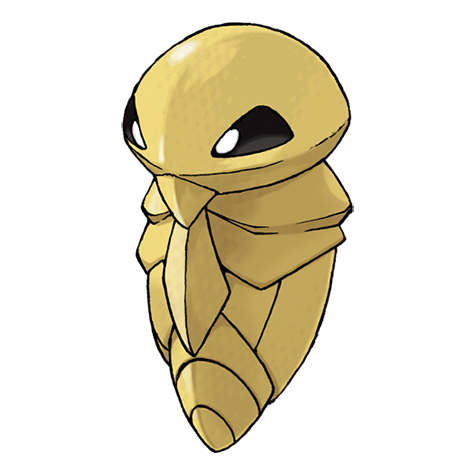
Almost incapable of moving, this POKéMON can only harden its shell to protect itself from predators.
- Height
- 0.6 m
- Weight
- 10.0 kg
- Base XP
- 72
- Catch
- 120 /255
- Happy
- 70
- Hatch
- 15 steps
- HabitatForest
- Body shapeSquiggle
- ColourYellow
- Growth rateMedium
- Egg groupsBug
- RarityStandard
Kakuna is the Cocoon Pokémon, a dual Bug and Poison type introduced in the first generation of Pokémon. It occupies an intermediate stage in its evolutionary line, bridging the larval and fully developed adult forms. Physically, Kakuna resembles a pale yellow teardrop or elongated oval, slightly pointed at the top and flat along the underside. Its body is encased in a hardened outer shell that gives it the unmistakable appearance of an insect chrysalis. Two small, dark eyes peer out from the upper portion of its form, and a pair of tiny, stubby appendages — vestigial arms — extend from its sides. Roughly two feet in height, Kakuna is compact and lightweight, standing at approximately knee height to an average adult human. Its surface is smooth and waxy with a faint yellowish sheen, and that shell hardens progressively as the organism inside continues to develop.
Kakuna is found primarily in forested regions, favouring temperate woodlands and dense groves where tree cover is abundant. It appears with regularity in areas such as Viridian Forest in the Kanto region, as well as similar wooded zones across multiple regions throughout the world. Kakuna typically attaches itself to tree branches or trunks, hanging motionless among leaves and bark where its yellow colouration provides a degree of camouflage against dappled light and autumn foliage. It is almost always encountered alone or in small, loosely spaced clusters, never gathering into organised social groups. Because it is physically incapable of relocating on its own, its distribution is almost entirely determined by where it evolved from Weedle, making it dependent upon environments already known to support the larval stage. Populations tend to be denser in areas with rich undergrowth and abundant plant life that sustained the feeding activity of Weedle earlier in the life cycle.
Kakuna is among the least active Pokémon in existence. It does not feed at this stage of development, drawing instead on energy reserves accumulated while it lived as a Weedle. It remains essentially stationary, anchored to a surface, with virtually no capacity for voluntary movement of any kind. The interior of the shell, however, is far from dormant — the organism within undergoes rapid and extensive cellular reorganisation as it prepares to take on its adult form. The shell itself can grow noticeably warm to the touch as this internal metabolic process intensifies, a detail field researchers frequently report when examining living specimens attached to trees. Kakuna's only observable behavioural response to external threat is a passive hardening of its outer casing, a reflex that requires almost no energy expenditure. Observers describe it as entirely non-aggressive, though this is less a reflection of temperament and more a direct consequence of the profound physical constraints that define this transitional stage.
The sole ability Kakuna possesses is Shed Skin, a passive regenerative trait that periodically allows the Pokémon to recover from status conditions such as paralysis, sleep, burns, or poisoning by sloughing away a thin layer of its outer membrane. This ability activates at the end of each turn in battle and provides meaningful passive resilience for a Pokémon that cannot take offensive action on its own. In terms of typing, the combination of Bug and Poison leaves Kakuna vulnerable to Flying, Rock, Fire, Ground, and Psychic type attacks, meaning it faces serious threats from a broad range of opponents. Its most notable defensive attribute is the hardness of its shell, which grants genuine protection against physical strikes. Attacking power and speed are both limited, however, and Kakuna is rarely deployed as an active combatant in its own right. Trainers who include it in battle generally do so either out of necessity during the raising process or specifically to observe how long the shell and Shed Skin together can sustain it against incoming pressure.
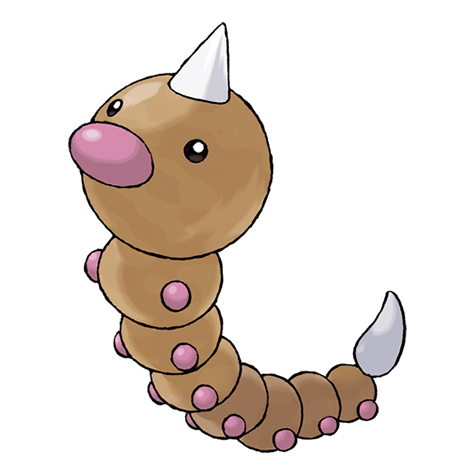
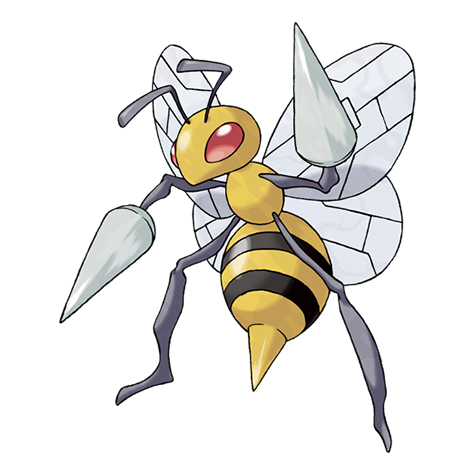
Kakuna occupies the second stage of a three-part evolutionary line. It evolves from Weedle beginning at level seven, and then continues onward into Beedrill beginning at level ten, one of the earliest evolution thresholds found anywhere in the Pokédex. The brevity of its stay at this intermediate stage is remarkable — Kakuna spends only a narrow window as a cocoon before completing its metamorphosis into a fully mobile, airborne Pokémon equipped for active and aggressive combat. For researchers studying insect-type Pokémon biology, Kakuna is a compelling illustration of holometabolism, the process by which a grub-like organism undergoes complete internal restructuring to emerge as a complex, winged adult. Trainers in the earliest stages of their journeys frequently encounter Kakuna as one of the first cocoon-stage Pokémon they are likely to see, making it an early practical lesson in patient, long-term Pokémon development. Its brief but indispensable role as the gateway to Beedrill keeps Kakuna relevant to competitive breeders and casual players alike.