Beedrill
Poison Bee Pokémon
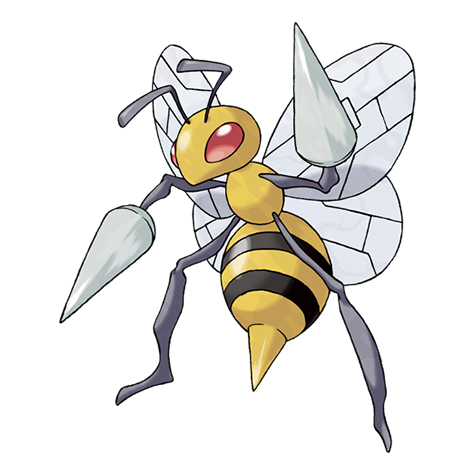
It has three poisonous stingers on its forelegs and its tail. They are used to jab its enemy repeatedly.
- Height
- 1.0 m
- Weight
- 29.5 kg
- Base XP
- 178
- Catch
- 45 /255
- Happy
- 70
- Hatch
- 15 steps
- HabitatForest
- Body shapeBug Wings
- ColourYellow
- Growth rateMedium
- Egg groupsBug
- RarityStandard
Beedrill is the Poison Bee Pokémon, a dual Bug and Poison type that made its debut in the very first generation of Pokémon games. In form it strongly resembles a large, predatory wasp, standing roughly at the level of an adult human's midsection when perched, though its wingspan stretches considerably wider. The body is strikingly yellow, broken by broad black bands across its segmented abdomen and tipped by a sharp, elongated stinger at its tail. Its eyes are a vivid red, giving it an alert and intense expression. Most distinctive of all are the two heavy, lance-like stingers mounted on its front limbs, which it uses much like arms, making Beedrill one of the few insect-type Pokémon whose offensive weaponry is integrated so visibly into its body plan. Two pairs of translucent wings power its flight, producing a loud buzzing hum that experienced trainers learn to recognize as an early warning sign.
Beedrill inhabits forests and dense woodlands across many regions, with confirmed populations in Kanto, Johto, and similar temperate forested environments elsewhere. It is a highly social species, living in large colonies that stake out and aggressively defend substantial territories within the forest. Nests are typically established in dense brush or in the hollows and branches of mature trees, kept carefully hidden from the edges of trails and human paths. While Beedrill are encountered singly by trainers venturing into tall grass near forested areas, solitary individuals are the exception rather than the rule. The species is most active during daylight hours, patrolling the perimeter of its colony's territory in rotating shifts, though the nest remains guarded around the clock. Populations tend to be denser in warmer seasons and in regions where flowering plant life is abundant, as this directly supports the colony's food supply.
Beedrill feeds on plant matter and floral resources, with individual foragers collecting pollen and sap to bring back to the colony. It is, however, far better known among field researchers for its territorial aggression than for its diet. When any creature is perceived as a threat to the nest, Beedrill mobilize instantly and in numbers, pursuing the intruder at speed and driving their stingers in rapid, repeated jabs rather than a single sting. The venom delivered through these stingers is potent, and the sheer persistence of the attack rarely allows a target time to escape without injury. Within the colony, communication is handled through wing vibration patterns and chemical signals that can coordinate hundreds of individuals simultaneously. Trainers who have spent time with Beedrill consistently note that the species, once it extends loyalty to a trainer, is fiercely devoted, but that building that bond demands patience and calm, unhurried interaction.
In battle, Beedrill is built around its physical attack power and its solid speed, which together allow it to strike hard and often before slower opponents can mount a defense. Its standard ability, Swarm, strengthens its Bug-type moves when it has taken heavy damage, so a Beedrill fighting near its limit can suddenly land unexpectedly powerful blows. Its hidden ability, Sniper, multiplies the damage of any critical hit well beyond the normal increase, meaning that a lucky precise strike can be devastating. The Bug and Poison typing gives Beedrill natural resistance to Grass and Fighting moves, and its Poison-type attacks allow it to inflict ongoing poison damage that gradually wears down an opponent between turns. The significant weaknesses are to Psychic, Flying, Rock, Fire, and Ground attacks, and because Beedrill's defensive stats are modest, landing any of those moves cleanly is usually decisive. Most trainers deploy Beedrill as a fast, aggressive physical attacker that threatens poison and momentum rather than a durable frontline fighter.
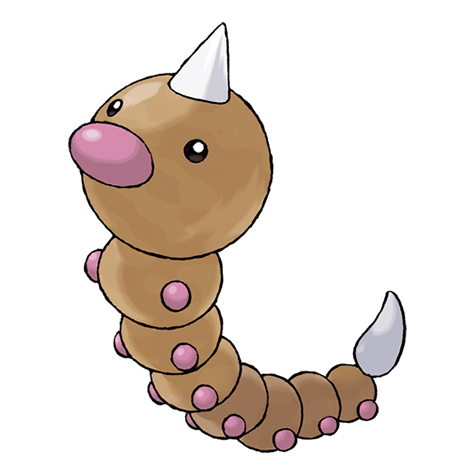
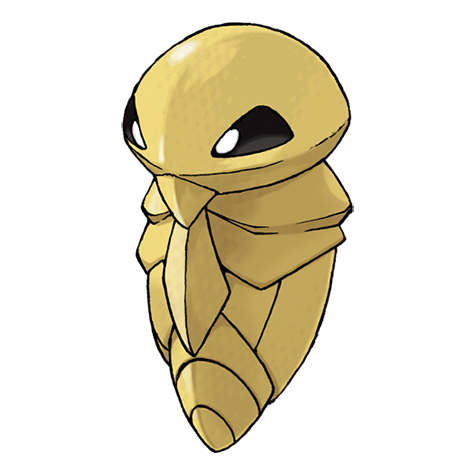
Beedrill is the final stage of a three-part evolutionary line that begins with Weedle, a small, spiny larval Pokémon, which evolves into the cocoon form Kakuna at level seven. Kakuna then evolves into Beedrill at level ten, giving this line one of the lowest evolution thresholds in the entire Pokédex and making a fully evolved Beedrill accessible to trainers very early in their journey. This swift progression from soft larva through inert chrysalis to armored predator compresses the biological arc of insect metamorphosis into a remarkably short window. As one of the original one hundred and fifty-one species, Beedrill carries genuine historical significance within the Pokédex, and its immediately recognizable silhouette has made it an icon of the earliest era of Pokémon. Researchers continue to study its colony communication systems and venom chemistry, while trainers appreciate its evolutionary accessibility and the genuine threat it poses when used by someone who understands how to protect its defensive gaps.