Pidgey
Tiny Bird Pokémon
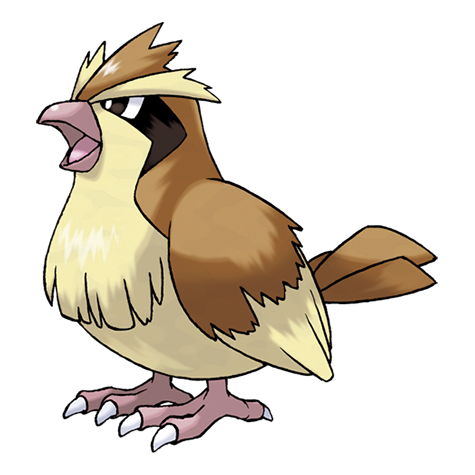
A common sight in forests and woods. It flaps its wings at ground level to kick up blinding sand.
- Height
- 0.3 m
- Weight
- 1.8 kg
- Base XP
- 50
- Catch
- 255 /255
- Happy
- 70
- Hatch
- 15 steps


- HabitatForest
- Body shapeWings
- ColourBrown
- Growth rateMedium Slow
- Egg groupsFlying
- RarityStandard
Pidgey is the Tiny Bird Pokémon, a Normal and Flying type that made its debut in the very first generation of Pokémon. Small enough to perch comfortably in an open palm, it stands roughly a foot tall, barely reaching the knee of an average adult, with a compact rounded body built for agility rather than power. Its plumage is a warm brown across the back and wings, fading to cream on the underside, and a distinctive mask of darker brown feathers sweeps back from each eye, lending it a perpetually alert expression. A short crest sits atop the head, the tail fans out from brown at the base to pale tan at the tips, and the feet are a soft pink. Despite its modest size, the wings are proportionally broad, shaped more for maneuvering through dense canopy than for long sustained flight.
Pidgey ranks among the most widely encountered Pokémon available to beginning trainers, inhabiting temperate forests, open woodlands, and the grassy margins where meadows meet tree cover across multiple regions. It favors exactly those transitional zones where food and shelter are equally accessible, making forest edges and rural farmland prime territory. In Kanto it appears on practically every early route, and equivalent populations have been documented across Johto and comparable biomes elsewhere. Pidgey tolerates human settlement well, often foraging near grain fields and low hedgerows where seeds and insects are reliably plentiful. It is not a notably migratory species, tending to maintain a loose home range year-round, though individuals may shift territory in response to severe weather. Juveniles frequently gather in small flocks for safety, while adults are just as often seen foraging alone or in loosely associated pairs.
Pidgey is diurnal, most active during morning and midday hours when insects and seeds are easiest to locate. It forages methodically across leaf litter and bare soil, targeting small ground-dwelling insects, fallen berries, and loose grain. When threatened, it does not always retreat immediately; instead, it beats its wings vigorously at ground level, churning up a blinding cloud of sand and dust that disorients aggressors long enough for a clean escape. Field researchers note that surprising a Pidgey in sandy terrain is considerably more hazardous than its harmless appearance suggests. Toward humans, Pidgey is famously docile, ranking among the least aggressive wild Pokémon on record, and patient trainers can often approach within a few steps before it retreats. Communication relies on soft cooing calls and rhythmic wing displays, and territorial disputes are generally resolved through posture and demonstration rather than direct physical confrontation.
Pidgey carries one of two standard abilities or a single hidden ability, each reflecting a different facet of its nature. Keen Eye prevents any opponent from reducing its accuracy, ensuring attacks land consistently against Pokémon that rely on sand, powder, or evasive techniques to throw off their rivals. Tangled Feet turns confusion into a defensive asset: when Pidgey is confused in battle, the disorientation paradoxically raises its evasiveness, making it harder to pin down during a chaotic exchange. Its hidden ability, Big Pecks, prevents external forces from lowering its Defense, protecting the solidity of its build against opponents who would otherwise erode its durability through repeated stat reductions. In battle Pidgey leans physical, using its respectable speed to strike first with moves such as Gust and Quick Attack. Its Normal and Flying typing grants a complete immunity to Ground-type attacks, but Rock, Ice, Electric, and Fighting moves all strike with added force. Experienced trainers value it primarily as a dependable early lead, prized for coverage and consistency rather than raw power.
Pidgey occupies the first stage of a three-stage evolutionary line. It evolves into Pidgeotto through accumulated battle experience, gaining considerably in size, endurance, and aerial strength. Pidgeotto later evolves into the fully mature Pidgeot, a swift and commanding Pokémon renowned for generating gale-force winds with a single sweep of its wings. Because Pidgey was among the first species formally catalogued in the Kanto region, the line holds an almost emblematic place in Pokémon research and trainer culture alike. Pidgey itself is frequently used as a model organism in introductory ecological studies: its behavior is well-documented, its range is extraordinarily broad, and its dual role as insectivore and accidental seed disperser gives it genuine ecological importance that extends well beyond its unassuming battle statistics. For countless trainers stepping into the wild for the very first time, a Pidgey is often the earliest reminder that even the most common Pokémon carries the potential for remarkable growth.