Weedle
Hairy Bug Pokémon
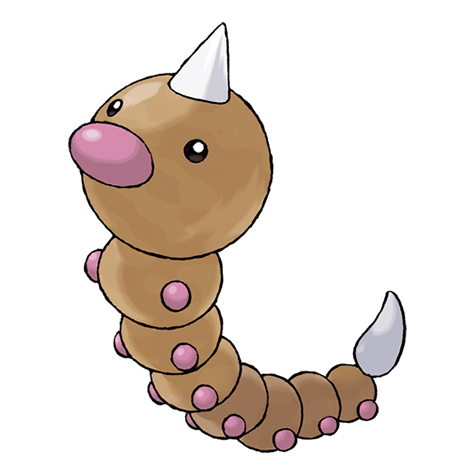
Often found in forests, eating leaves. It has a sharp venomous stinger on its head.
- Height
- 0.3 m
- Weight
- 3.2 kg
- Base XP
- 39
- Catch
- 255 /255
- Happy
- 70
- Hatch
- 15 steps
- HabitatForest
- Body shapeArmor
- ColourBrown
- Growth rateMedium
- Egg groupsBug
- RarityStandard
Weedle is a Bug and Poison type Pokémon originating from the first generation, classified officially as the Hairy Bug Pokémon. In form it resembles a small caterpillar, typically measuring no more than a few inches from head to tail — small enough to rest comfortably in a human's open palm. Its body is a warm golden brown, segmented and rounded, and is covered across its entire surface in fine, bristling hairs that give the species its common classification. The most immediately striking feature of Weedle is the long, pointed stinger that protrudes upward from the crown of its head. This needle-like horn is its primary means of defense and is laced with a fast-acting venom. A secondary, shorter spine is present at the tail, and a soft pink tinge marks the nose and the underside of the head. Despite its modest size, the combination of its venomous horn, toxic coating, and dense body hair makes Weedle a surprisingly formidable presence for a creature so new to the world.
Weedle is found predominantly in forested environments, and its range within the Kanto region concentrates heavily in areas such as Viridian Forest, where a dense canopy and plentiful foliage create ideal conditions for a small herbivore. It favors temperate woodland zones where broad-leaved trees and low shrubs provide both food and shelter. Because Weedle spends the majority of its brief larval existence feeding rather than traveling, it rarely ventures far from the trees it was born near. Populations can be quite dense in undisturbed forest interiors, though individual Weedle are largely solitary foragers and do not form structured groups or colonies. They are active during daylight hours, making them one of the more commonly sighted Bug type species for trainers moving through woodland routes. Weedle does not migrate and shows little variation in preferred habitat across the seasons, though it tends to climb higher into dense foliage during particularly warm periods to avoid ground-level heat.
Weedle's daily existence is almost entirely organized around eating. It consumes leaves almost continuously, processing large quantities of plant matter to fuel the metabolic demands of its rapid growth. Trainers and researchers who have observed Weedle in the field note that it can strip a small branch of its foliage within a matter of hours. The fine hairs covering its body are thought to serve a sensory function, detecting air movement and vibration, which helps Weedle register the approach of predators before visual contact is made. When threatened, Weedle does not flee immediately; instead it rears slightly and presents its head stinger as a warning. A sting from Weedle delivers a mild but noticeable venom that can cause localized swelling and irritation in larger creatures, serving as an effective deterrent against most common forest predators. Weedle is generally not aggressive toward humans and will typically withdraw into underbrush rather than engage if given the opportunity to retreat safely.
In battle, Weedle relies on its Bug and Poison typing to apply pressure with poisoning effects and to weather certain incoming attacks. Its ability, Shield Dust, is a notable defensive trait: it prevents the secondary effects of incoming moves from activating, meaning that attacks which would otherwise cause burns, paralysis, freezing, or flinching deliver only their direct damage. This makes Weedle harder to cripple with status-inflicting techniques than its frail physical defenses might suggest. Its hidden ability, Run Away, guarantees that it can escape any wild encounter without fail, which reflects its survival instinct above all other drives. Offensively, Weedle leans toward physical engagement and possesses reasonable foot speed for a creature of its developmental stage, though its overall combat endurance is limited. Its dual typing leaves it exposed to Flying, Rock, Fire, Ground, and Psychic type attacks, which makes early switching and careful positioning important when fielding Weedle in any competitive context.
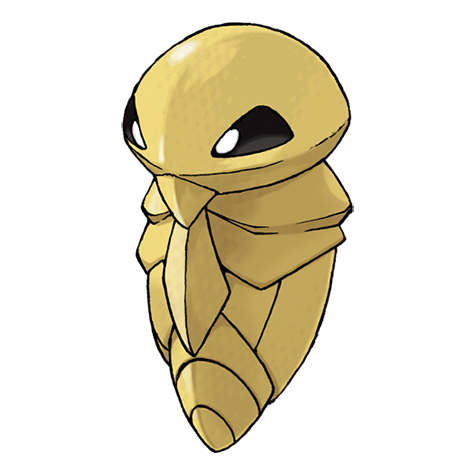
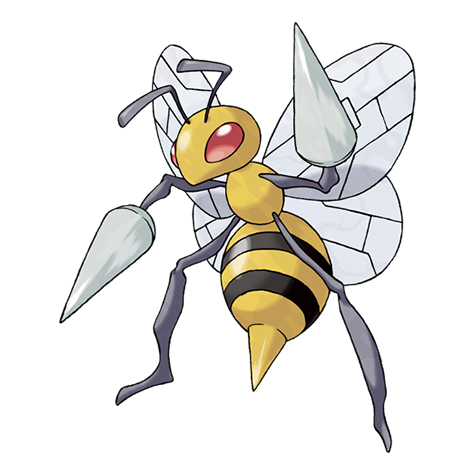
Weedle sits at the beginning of a compact three-stage evolutionary line. It evolves into Kakuna at level seven, making this one of the earliest evolutionary transitions in the entire Pokédex — a reflection of how brief the larval stage is in the biological cycle of this species. Kakuna then evolves into Beedrill at level ten, yielding a fast and offensively capable final form. This line runs parallel in structure to the Caterpie line, and both are considered foundational examples of the insect metamorphosis pattern that recurs across multiple generations of Pokémon. Researchers study Weedle primarily for its venom, which contains compounds of interest to those investigating natural toxins, and for the mechanics of its Shield Dust ability, which has broader implications for understanding how passive biological traits interact with external stimuli in battle conditions. For trainers new to the hobby, Weedle is often one of the first encounters that teaches the practical value of type matchups and the rewards of evolutionary patience.