Magneton
Magnet Pokémon
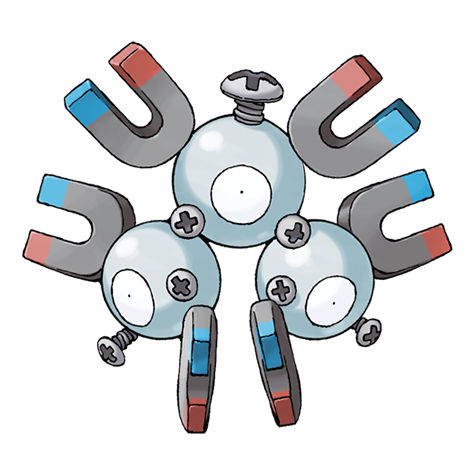
Formed by several MAGNEMITEs linked together. They frequently appear when sunspots flare up.
- Height
- 1.0 m
- Weight
- 60.0 kg
- Base XP
- 163
- Catch
- 60 /255
- Happy
- 70
- Hatch
- 20 steps
- HabitatRough Terrain
- Body shapeHeads
- ColourGray
- Growth rateMedium
- Egg groupsMineral
- RarityStandard
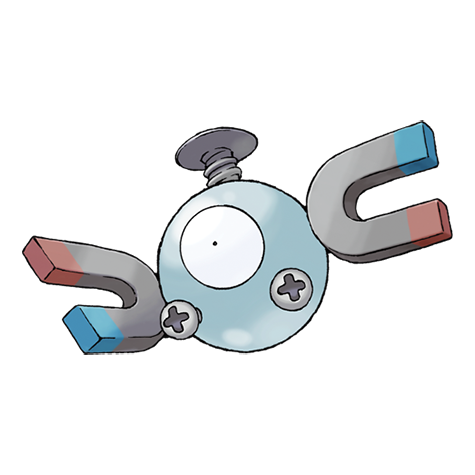
Magneton is the Magnet Pokémon, a dual Electric and Steel type that first appeared in the original generation of Pokémon. Its design is immediately recognizable: three individual Magnemite units fused together by a powerful magnetic force into a single cohesive form. Each component unit is a smooth, grayish-silver sphere bearing a single large eye and a pair of horseshoe-shaped magnets extending from its sides, along with small screw-like protrusions embedded in its metallic surface. The combined body stands roughly at waist height on an average adult, though its considerable metallic mass makes it substantially heavier than its compact silhouette might suggest. The three units hover in slight orbital motion around a shared center, held in formation not by any physical attachment but entirely by the enormous electromagnetic force they collectively generate.
Magneton gravitates toward areas with strong natural or artificial magnetic activity. It is most frequently encountered near power plants, electrical substations, and mountain ranges where ore deposits create unusual magnetic conditions in the surrounding terrain. In the wild, it tends to inhabit rough terrain and highland zones where electromagnetic interference runs high and human presence is sparse. Its populations are not evenly distributed across regions: Magneton can be scarce in temperate lowlands but surprisingly common in volcanic or mineral-rich areas where the earth itself amplifies magnetic fields. One of the most well-documented patterns in its behavior is the tendency to appear in sudden surges when sunspots flare up, suggesting a deep sensitivity to celestial electromagnetic events far above the surface. Though capable of hovering independently, groups of Magneton in the wild tend to drift into loose aggregations rather than wandering in complete isolation, their overlapping fields pulling them gradually together.
Magneton sustains itself by absorbing electricity directly from power lines, electrical equipment, and natural sources such as lightning during storms. This feeding behavior makes it a nuisance around human infrastructure, as a cluster of Magneton can drain a substation or disrupt local communications within a brief window of time. The strong magnetic field it emits interferes with electronic devices, compasses, and sensitive instrumentation within a significant radius, a trait that field researchers learn to account for quickly when studying this species. Toward humans, Magneton is neither aggressive nor especially approachable; it tends to exhibit indifference to organic life unless it perceives a direct threat. Its internal electromagnetic processes run continuously even during dormant periods, so a resting Magneton still radiates interference into its surroundings. Trainers who work closely with this species report that its form of communication consists of fluctuating radio-frequency pulses, a signal language that specialized receiving equipment can partially interpret.
In battle, Magneton functions primarily as a special attacker, drawing on a very high special attack capability to deliver powerful Electric-type moves and a range of Steel-type coverage. Its standard ability, Magnet Pull, creates a magnetic field around the battlefield that prevents Steel-type opponents from retreating or switching out, making Magneton a specialist at trapping and dismantling Steel-type threats before they can escape. The alternative standard ability, Sturdy, provides a safety net when Magneton enters battle at full health, ensuring that no single strike can knock it out in one blow and also rendering it immune to the category of moves designed to achieve instant knockouts. The hidden ability, Analytic, rewards a reactive approach: when Magneton acts after its opponent in a given turn, its moves gain a meaningful boost in power, encouraging deliberate and patient play. The Electric and Steel dual typing provides a strong defensive profile against a wide array of common move types, including Normal, Flying, Rock, Bug, Grass, and Dragon. However, clear vulnerabilities to Ground, Fire, and Fighting-type moves remain, and any of these can exploit the relatively modest overall bulk that Magneton carries outside of its physical defense, which is considerably more resilient than its hit point total might otherwise imply.
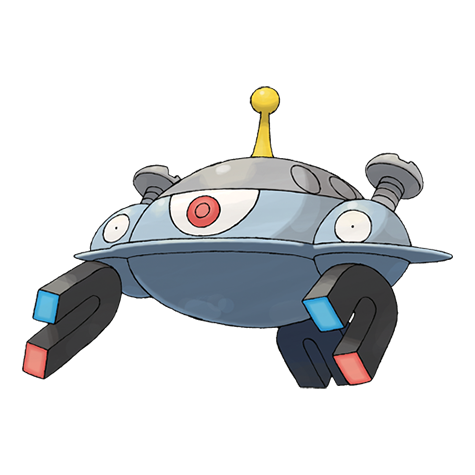
Magneton evolves from Magnemite, a small single-unit Electric and Steel type, and this transition occurs when Magnemite accumulates enough experience in the field to reorganize into the three-unit cluster. From Magneton, a further evolution remains possible: exposure to a powerful magnetic field, of the kind found in specific geological formations across several regions, triggers a deeper restructuring that produces Magnezone, the fully mature form of this line. Within the broader Pokédex, Magneton occupies the middle stage of a three-part evolutionary family, representing the point at which individual magnetic units begin organizing into something approaching a collective organism. Researchers find Magneton particularly valuable for studying the relationship between magnetism and coordinated behavior, since the three component units appear to share a degree of synchronized awareness despite lacking any single central nervous system. For competitive trainers, the capacity to lock down Steel-type opponents with Magnet Pull makes it one of the more tactically distinctive middle-stage Pokémon available, and its contributions to team strategy extend well beyond what its intermediate evolutionary status might initially suggest.