Configuration
This page covers all configuration formats used across Pagesmith: the ContentLayerConfig for @pagesmith/core and the pagesmith.config.json5 for @pagesmith/docs.
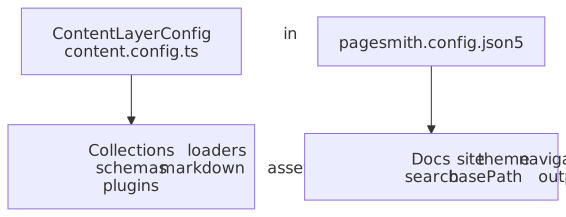
Notice you rarely mix concerns—core config feeds loaders and validation; docs config shapes the generated site and deploy output.
ContentLayerConfig
The configuration object passed to defineConfig() and createContentLayer():
import { defineConfig } from "@pagesmith/core";defineConfig({ // Named content collections (required) collections: { posts, pages, authors }, // Root directory for resolving relative paths (defaults to cwd()) root: process.cwd(), // Markdown processing configuration markdown: { remarkPlugins: [], rehypePlugins: [], shiki: { themes: { light: "github-light", dark: "github-dark", }, langAlias: { hbs: "handlebars" }, defaultShowLineNumbers: true, }, }, // Asset hashing configuration (consumed by @pagesmith/site's build pipeline) assets: { hashFilenames: false, outputDir: undefined, }, // Throw on file load errors instead of recording per-entry error issues strict: false, // Content plugins for pipeline extension and validation plugins: [],});ContentLayerConfig Fields
| Field | Type | Default | Description |
|---|---|---|---|
collections |
CollectionMap |
Required | Named collection definitions |
root |
string |
process.cwd() |
Root directory for resolving relative collection paths |
markdown |
MarkdownConfig |
{} |
Markdown pipeline configuration |
assets |
{ hashFilenames?: boolean; outputDir?: string } |
undefined |
Asset hashing configuration. @pagesmith/core only stores this; @pagesmith/site/@pagesmith/docs consume it during build. |
strict |
boolean |
false |
When true, throw on file load errors. When false, record per-entry error issues and continue with empty data. |
plugins |
ContentPlugin[] |
[] |
Content plugins for pipeline and validation |
The content layer caches loaded entries internally; there is no cache or eager toggle. To force a refresh, call layer.invalidate(), layer.invalidateCollection(), or layer.invalidateAll().
CollectionDef
The collection definition object passed to defineCollection():
| Field | Type | Required | Default | Description |
|---|---|---|---|---|
loader |
LoaderType | Loader |
Yes | — | Built-in loader type string ('markdown', 'json', 'json5', 'jsonc', 'yaml', 'toml') or a custom Loader instance |
directory |
string |
Yes | — | Directory containing collection files, relative to root |
schema |
ZodType |
Yes | — | Zod schema for validating entry data |
include |
string[] |
No | Derived from loader | Glob patterns to include (defaults to **/*<ext> from loader extensions) |
exclude |
string[] |
No | [] |
Glob patterns to exclude |
computed |
Record<string, (entry) => any> |
No | {} |
Computed fields merged into entry.data after validation |
transform |
(entry: RawEntry) => RawEntry |
No | Identity | Pre-validation transform (can be async) |
filter |
(entry) => boolean |
No | Always true | Post-validation filter; return false to exclude |
slugify |
(filePath, directory) => string |
No | toSlug() |
Custom slug generation from file path |
validate |
(entry) => string | undefined |
No | — | Lightweight validation hook; return string to report error |
validators |
ContentValidator[] |
No | [] |
Custom content validators (for markdown AST inspection) |
disableBuiltinValidators |
boolean |
No | false |
Disable built-in link, heading, code block, and image structure validators |
MarkdownConfig
Customizes the unified markdown processing pipeline:
type MarkdownConfig = { remarkPlugins?: any[]; rehypePlugins?: any[]; allowDangerousHtml?: boolean; math?: boolean | "auto"; images?: { lazyLoading?: boolean; eagerCount?: number; }; shiki?: { themes: { light: string; dark: string }; langAlias?: Record<string, string>; defaultShowLineNumbers?: boolean; };};| Field | Type | Default | Description |
|---|---|---|---|
remarkPlugins |
any[] |
[] |
Additional remark plugins, injected after built-in plugins and before remark-to-rehype conversion |
rehypePlugins |
any[] |
[] |
Additional rehype plugins, injected after built-in plugins and before HTML serialization |
allowDangerousHtml |
boolean |
true |
Preserve raw HTML from markdown. Disable this when rendering untrusted content. |
math |
boolean | 'auto' |
'auto' |
Always enable math plugins, disable them, or auto-enable them only for markdown that contains math markers. |
images.lazyLoading |
boolean |
true |
Emit loading/decoding/fetchpriority loading hints on content images. false adds no loading attributes at all. |
images.eagerCount |
number |
1 |
Leading images (document order) marked eager with fetchpriority="high" instead of lazy. 0 makes every image lazy. |
shiki.themes |
{ light: string; dark: string } |
{ light: 'github-light', dark: 'github-dark' } |
Dual theme names for built-in code renderer syntax highlighting |
shiki.langAlias |
Record<string, string> |
undefined |
Map of custom language aliases to language identifiers (e.g., { dockerfile: 'docker' }) |
shiki.defaultShowLineNumbers |
boolean |
true |
Show line numbers on code blocks by default. Individual blocks can override with showLineNumbers=false. |
Image loading hints
When images.lazyLoading is enabled (the default), Pagesmith walks the rendered images in document order: the first eagerCount images get fetchpriority="high" (tuned for the Largest Contentful Paint hero image), and every image after that gets loading="lazy" decoding="async". The hint applies to the <img> inside a generated <picture> as well as to a plain image, and an <img> that already carries an author-set loading or fetchpriority attribute is left untouched.
markdown: { images: { eagerCount: 2, // treat the first two images (e.g. a hero + immediate follow-up) as eager },}Set images.lazyLoading: false to opt out entirely and leave content images without any Pagesmith-added loading attributes.
Plugins can be passed as bare functions or [plugin, options] tuples:
markdown: { remarkPlugins: [ remarkEmoji, [remarkToc, { heading: 'contents' }], ], rehypePlugins: [ [rehypeExternalLinks, { target: '_blank' }], ],}ContentPlugin
Plugins extend the markdown pipeline and validation:
type ContentPlugin = { name: string; rehypePlugin?: () => (tree: any) => void; remarkPlugin?: () => (tree: any) => void; validate?: (entry: { data: Record<string, any>; content?: string }) => string[];};remarkPluginandrehypePluginare appended to the pipeline during rendering.validateruns during the loading phase, after schema and content validators. Returnsstring[]of error messages.
pagesmith.config.json5
The @pagesmith/docs package is configured through a JSON5 file. See the Docs Configuration Reference for the full specification.
Quick example:
{ name: "My Docs", title: "My Project Documentation", contentDir: "./content", outDir: "./dist", basePath: "/", trailingSlash: false, // false → path.html output; true → path/index.html search: { enabled: true }, markdown: { shiki: { themes: { light: "github-light", dark: "github-dark" }, }, },}Collection Defaults
- Loader-specific include globs are inferred automatically from the loader’s
extensionsarray. - Built-in markdown validators (link, heading, code block, image structure) are enabled unless
disableBuiltinValidatorsis set. - Schema validation returns structured issues and preserves raw data when parsing fails, so entries with validation errors are still accessible.
- The markdown processor is cached per
MarkdownConfigobject reference via aWeakMap, avoiding pipeline reconstruction on every call.